5 Ways to Speed Up Your Six-Pack
From Ben Kallen - Content Manager at BODi
No matter what your age, body type, or fitness
level, we're pretty sure one of your main workout goals is to improve your abs.
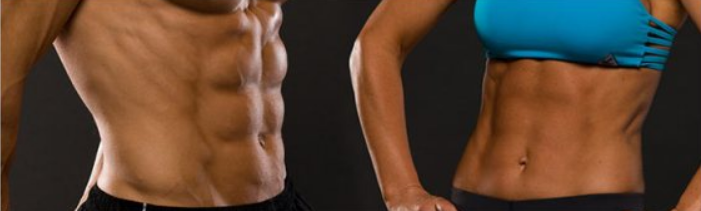
And why not? A flat midsection, with or without a visible six-pack, is the
ultimate symbol of being fit and lean. (And yes, it looks great at the beach.)
But it's not just a matter of vanity - a strong core helps stabilize your
entire body. That's why every BODi workout program includes a variety of
ab-tightening exercises.
Still, whatever you're doing to get fit,
there's always room for improvement where the core is concerned. Here are five
tips to help you to get those great abs faster than ever:
- Work your entire
core. Your "core" (the trunk muscles of your
abdomen, lower back, and pelvis) is a whole system that supports your body as
you stand up straight, perform everyday activities, and work out. And it's
important to strengthen all these muscles, not just the rectus abdominis (the
main "six-pack" muscles targeted by crunches). At the very least, you should
strengthen the spinal erectors of the lower back to balance out your abs, which
will help your posture and reduce the risk of back pain. Think of total-core
training as increasing your functional fitness - meaning you won't just look
better, but you'll also be able to do things better. (P90X's Core Synergistics
workout and ChaLEAN Extreme's Extreme Abs workout are great examples of
complete core workouts.)
 Take it
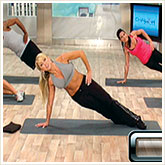
slow. When you're doing crunches or other
ab-focused exercises, it's easy to speed up and lose proper form, especially
when you start to get tired. Either you let momentum carry you through much of
the movement or you pull yourself up with your back and shoulders. But you'll
get the most benefit (and the least chance of injury) from your workout if you
concentrate on measured, controlled movements. And keep the abdominals
contracted the entire time. After all, they're the ones that should be doing
the work. (Doing some Pilates-style movements - like ChaLEAN Extreme's Pilates
Roll-Up, in which you lift your upper body to a count of 8 is a good way to
train yourself to slow it down.) When you can't do any more reps with the
proper form, it's time to stop. Take it
slow. When you're doing crunches or other
ab-focused exercises, it's easy to speed up and lose proper form, especially
when you start to get tired. Either you let momentum carry you through much of
the movement or you pull yourself up with your back and shoulders. But you'll
get the most benefit (and the least chance of injury) from your workout if you
concentrate on measured, controlled movements. And keep the abdominals
contracted the entire time. After all, they're the ones that should be doing
the work. (Doing some Pilates-style movements - like ChaLEAN Extreme's Pilates
Roll-Up, in which you lift your upper body to a count of 8 is a good way to
train yourself to slow it down.) When you can't do any more reps with the
proper form, it's time to stop.
- Don't overdo it.
If you really want great abs, you may be tempted to
grind out crunch after crunch to the exclusion of other exercises, or to do
more ab-centered workouts than your fitness program recommends. But directly
working your abs too often can do more harm than good. Like any muscle, the
abdominals need to recover between workouts. If you find you aren't improving
the number of reps you can do or the amount of weight you can handle, that's a
sign that you're overtraining, and you need to cut back.
- Don't neglect the rest of your
body. The more you work your entire body, the
better it is for your abs. In fact, just about any full-body or compound
movement, from push-ups to squats to deadlifts, takes a lot of ab effort.
What's more, working your full body will burn many more calories and raise your
metabolism, which is important, because you also need to . .
.
 Lose
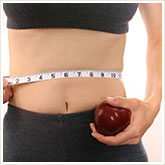
the fat to make your abs flat. No matter how much
you strengthen your abdominal muscles, the only way to get a flat midsection is
to lose body fat. That's going to require a diet that's high in protein and
fiber, low in simple carbs, and full of bulky, nutrient-dense foods that keep
you full with fewer calories - and of course, plenty of water. If you're on a
meal plan associated with a particular workout, make sure you're really
following it and not fudging here and there. (Keeping a food diary can help.)
When you combine an effective full-body workout with a proper diet, getting the
flat abs you've always wanted is just a matter of time. Lose
the fat to make your abs flat. No matter how much
you strengthen your abdominal muscles, the only way to get a flat midsection is
to lose body fat. That's going to require a diet that's high in protein and
fiber, low in simple carbs, and full of bulky, nutrient-dense foods that keep
you full with fewer calories - and of course, plenty of water. If you're on a
meal plan associated with a particular workout, make sure you're really
following it and not fudging here and there. (Keeping a food diary can help.)
When you combine an effective full-body workout with a proper diet, getting the
flat abs you've always wanted is just a matter of time. |
|
 Get
Fitter
Get
Fitter Get
Stronger
Get
Stronger Fuel
Your Body
Fuel
Your Body Then Run
With It
Then Run
With It