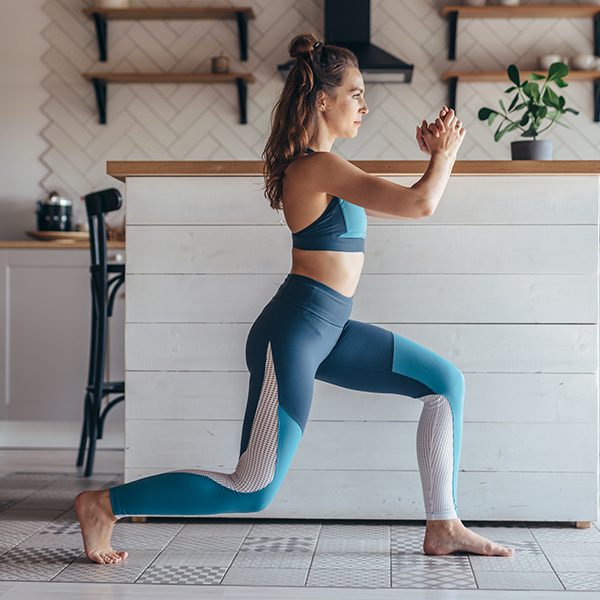
Functional fitness is doing every day activities, like getting up off the floor, picking up something safely or lifting something overhead. You want to make sure that as the years go by, you don’t just add life to your years, but capability to your life. Scroll down to find out how.
Functional Fitness: Training for the Sport of Life
We’ve all seen it: the gym regular who can bench press 300 pounds but throws their back out reaching for a bag of groceries, or the runner who can clock a sub-20-minute 5K but struggles to sit on the floor and get back up.
At Howtobefit.com, we call this “isolated fitness.” It looks good in the mirror, but it doesn’t always translate to the real world. If you want to build a true Health Retirement Fund, you need Functional Fitness.
What is Functional Fitness?
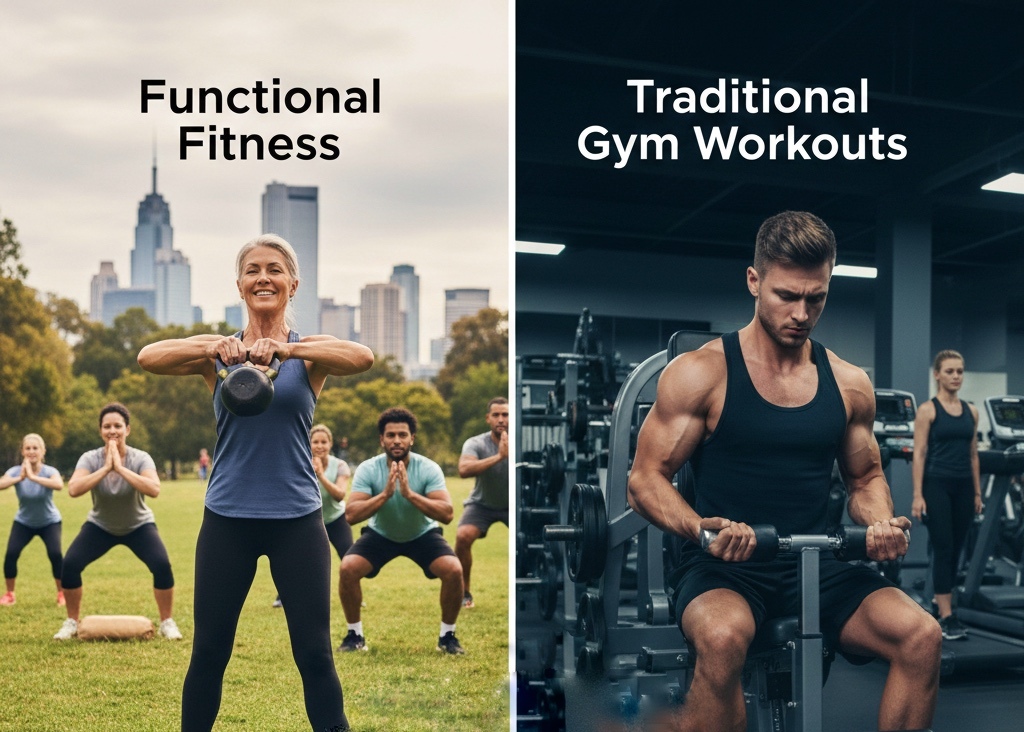
Functional fitness is a classification of training that prepares the body for real-life movements and activities. Unlike traditional bodybuilding, which often uses machines to isolate a single muscle (like a bicep curl), functional training focuses on movements, not muscles.
It mimics the way you move in your daily life—squatting, reaching, pulling, and lifting—by engaging multiple muscle groups and joints simultaneously.
The 3 Pillars of a Functional Body
To stay capable well into your 80s and 90s, your training should focus on these three outcomes:
1. Multi-Planar Movement
Most gym machines move in a single straight line (the sagittal plane). Life, however, happens in 3D. Functional fitness incorporates side-to-side (frontal) and rotational (transverse) movements. This strengthens the stabilizing muscles that prevent falls and joint injuries.
2. Core Stability (Beyond Six-Pack Abs)
In functional training, your core isn’t just for show; it’s the bridge that transfers power from your legs to your upper body. Whether you’re swinging a golf club or carrying a heavy suitcase, a functional core keeps your spine safe under load.
3. Balance and Proprioception
As we age, our “proprioception”—the body’s ability to sense its location in space—naturally declines. Functional exercises often involve uneven loads or single-leg movements to challenge your balance, keeping your nervous system sharp.
Real-World Examples
-
The Squat: In the gym, it’s a leg exercise. In life, it’s how you get out of a chair or a car.
-
The Deadlift: In the gym, it’s a back/glute exercise. In life, it’s how you safely pick up a grandchild or a heavy box.
-
The Overhead Press: In the gym, it’s a shoulder exercise. In life, it’s how you put away luggage in an overhead bin.
How to Start Investing Today
You don’t need a specialized “functional gym” to start. You can begin by simply swapping one machine-based exercise for a free-weight or bodyweight alternative.
To support the high-intensity nature of functional movements and ensure your joints are protected, I highly recommend focusing on your recovery nutrients.
Nordic Naturals Ultimate Omega is vital here. Functional training puts a lot of demand on your joints and heart. These high-potency Omega-3s help reduce the inflammation caused by varied, multi-joint movements, ensuring you stay “oiled” and ready for the next session.
Functional fitness is the ultimate “blue-chip stock” in your Health Retirement Fund. It ensures that as the years go by, you don’t just add life to your years, but capability to your life.