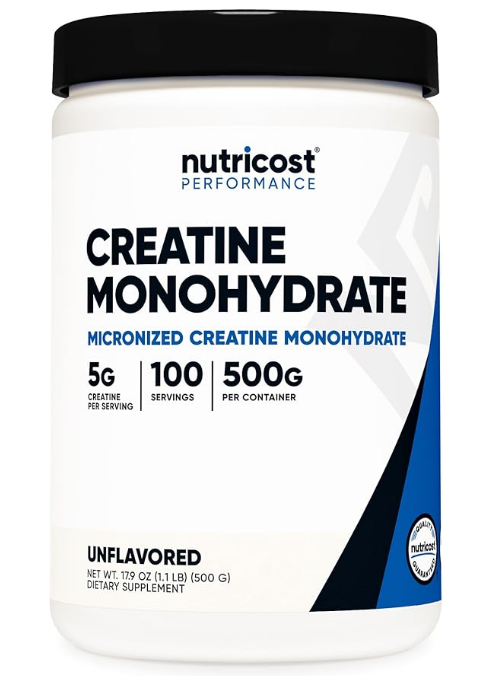
The science behind creatine is extensive, and because of that, we know that it isn’t just for bodybuilders, but for everyone who works out and wants better performance and recovery should use it. I have been using creatine for about 9 months, and I am on track to have one of my best years yet on Strava. I chose Nutricost Creatine because of the reviews and cos,t and it has worked exceptionally well for me. Scroll down to learn the science behind creatine and why you should be using it.
Of all the supplements lining the shelves of health food stores, creatine stands in a class of its own. It’s not a flash-in-the-pan trend; it’s one of the most extensively researched, safest, and effective performance-enhancing aids available. But how does this simple white powder actually work?
The magic isn’t really magic at all—it’s pure biochemistry. Let’s dive into the science behind how creatine gives you that extra edge in the gym and beyond.
What Is Creatine, Anyway?
First, let’s demystify what it is. Creatine is not a synthetic drug or a steroid. It’s a naturally occurring organic compound that your body produces from amino acids. It’s found primarily in your muscles (about 95%), with smaller amounts in your brain and testes. You also consume it through your diet, especially from red meat and fish.
When you take a creatine supplement, you’re simply increasing your body’s natural stores of this compound. Think of it as topping off a fuel tank that’s designed for explosive power.
The Core Mechanism: Your Body’s “Turbo Boost”
The science of creatine boils down to energy. Specifically, it revolves around a molecule called Adenosine Triphosphate ().
is the primary energy currency of every cell in your body. When you perform any action—from blinking to lifting a heavy barbell—your body “spends” . This is done by breaking a phosphate bond, turning into Adenosine Diphosphate () and a free phosphate ion (), which releases a burst of energy.
The problem? Your muscles only store enough for a few seconds of all-out, high-intensity effort. To continue, your body must rapidly regenerate . This is where creatine comes in.
Most of the creatine in your muscles is stored as phosphocreatine (). This molecule is essentially a creatine with a high-energy phosphate group attached. When is used up and becomes , phosphocreatine swoops in and donates its phosphate group to the molecule.
The key reaction looks like this:
This reaction, catalyzed by the enzyme creatine kinase, instantly regenerates , allowing your muscles to maintain a high power output for a few more seconds.
By supplementing with creatine, you increase your muscle’s stores of phosphocreatine (). More means you can regenerate more quickly and for longer during intense efforts. This translates directly to being able to squeeze out one or two more reps on a heavy set or sprint for a couple of seconds longer. That extra work, compounded over time, is what drives significant gains in strength and muscle mass.
From Energy to Results: The Proven Benefits
This rapid energy recycling leads to several well-documented benefits:
- Increased Strength and Power: This is the most reliable and immediate effect. More available energy for short bursts means better performance in weightlifting, sprinting, and jumping.
- Enhanced Muscle Growth (Hypertrophy): Creatine helps you build muscle in two ways. Primarily, the ability to perform more work (volume) in the gym is a key stimulus for muscle growth. Secondarily, creatine acts as an osmolyte, drawing water into your muscle cells. This process, known as cell volumization, can signal anabolic (muscle-building) pathways. So no, it’s not “just water weight”—it’s functional water that can contribute to long-term muscle gains.
- Improved Anaerobic Capacity: Any activity that relies on short, intense bursts of energy can be improved by creatine supplementation.
Beyond the Biceps: Creatine’s Role in Brain Health
Your brain is an incredibly energy-hungry organ, also relying heavily on the system. It makes sense, then, that increasing creatine stores could have cognitive benefits.
Emerging research is exciting in this area. Studies suggest that creatine supplementation may:
- Improve short-term memory and reasoning skills.
- Enhance cognitive function, especially during stressful situations like sleep deprivation or complex problem-solving.
- Offer neuroprotective benefits in certain conditions.
While the research is still developing, it’s clear the benefits of creatine aren’t just for your muscles.
Is It Safe? Busting the Myths
Creatine is one of the most studied supplements on the planet, and the scientific consensus is clear: it is safe for long-term use in healthy individuals.
- Kidney Damage: This is the most persistent myth, but it has been thoroughly debunked by dozens of studies. In people with healthy kidney function, long-term creatine use has shown no harmful effects.
- Dehydration and Cramping: This theory was once popular but has also been proven false. In fact, by pulling water into muscle cells, creatine actually improves your overall hydration status and may help reduce the risk of cramping.
For most people, a daily dose of 3-5 grams of creatine monohydrate—the most researched form—is all that’s needed to saturate your muscles and reap the benefits.
In conclusion, creatine’s reputation is built on a solid foundation of science. By optimizing your body’s most immediate energy system, it allows you to work harder, get stronger, and recover faster. It’s a simple, safe, and powerful tool for anyone looking to unlock their full potential.