What's the Difference
Between P90X and P90X2? By Steve Edwards
From
BODi Fitness &
Health
What's the difference between
P90X® and
P90X2™? This is the
question of the year, and it can't be answered in one simple sentence, or even
one article. So I've written this series to help you decide whether or not
P90X2 is the program for you. I wish I could tell all of you that P90X2 is
right for you, but I'm too responsible for that. I'm sure one program in
Beachbody's huge collection will work for each of you, but if you want to know
specifically whether that right one is P90X2, read on.

- Is P90X2 better than P90X?
How can you beat the most popular workout program in the country? You
can't. P90X2 is an extension of P90X. It's not necessarily better, but it's
definitely evolved. For a more in-depth look at its development, read the first
article in this series (see "The Next X: What's New About P90X2?" in the
Related Articles section below).
 Is it
more Muscle Confusion™? You betcha! If you thought your
muscles were confused last time around, you ain't seen nothin' yet! Is it
more Muscle Confusion™? You betcha! If you thought your
muscles were confused last time around, you ain't seen nothin' yet!- Is it harder? Remember the
first time you did P90X? Could anything feel harder than that? Probably not. So
while P90X2 isn't technically harder, it's probably going to feel harder until
you get used to it. And since it's Muscle Confusion, it's going to take you
some time to adapt. During this adaptation period, it's going to feel very
difficult, but you're used to that, right? And when you take your X2 body back
to another round of P90X, that program's going to feel harder too, because
you'll be prepared to push yourself farther than ever before.
 Is it still 6 days per week? No, it's only 5, though we
suggest active recovery on your rest days. The more intensely you work out, the
less time you need to spend doing it. With more breakdown, you also need more
rest. P90X2 has evolved to the point where less is more. Is it still 6 days per week? No, it's only 5, though we
suggest active recovery on your rest days. The more intensely you work out, the
less time you need to spend doing it. With more breakdown, you also need more
rest. P90X2 has evolved to the point where less is more. - Will there be options like Lean and
Doubles? Instead of giving you different program options, P90X2 gives you
the option of increasing each phase long enough to get the most out of it. If
you're having trouble with your balance, you may decide to spend more time in
Phase One. For bigger muscles, spend more time in Phase Two. Want to get
faster, jump higher, or become more agile? Spend more time mastering Phase
Three. You'll definitely want to read the guidebook, because it provides ideas
for how to tailor your training personally for you (and much more). In P90X, we
made the most versatile home fitness program ever created. P90X2 will open up
even more options.
 Is it true that there's no cardio?
Here's a little secret: There was no true cardio in P90X, either. At
least not in the kind of training generally associated with that word. P90X
used anaerobic interval training to improve your cardiovascular system;
although it's technically cardio, it isn't the public perception of cardio.
"Cardio" is a training colloquialism for training your heart. So while you
won't see any cardio in the title names, doing Plyocide or P.A.P. Lower will
train your cardiovascular system as well as any cardio routine you've ever
done. Is it true that there's no cardio?
Here's a little secret: There was no true cardio in P90X, either. At
least not in the kind of training generally associated with that word. P90X
used anaerobic interval training to improve your cardiovascular system;
although it's technically cardio, it isn't the public perception of cardio.
"Cardio" is a training colloquialism for training your heart. So while you
won't see any cardio in the title names, doing Plyocide or P.A.P. Lower will
train your cardiovascular system as well as any cardio routine you've ever
done.- Will I need any new equipment?
There's a lot of new equipment for P90X2, and you'll eventually want to
own all of it. But the cool thing is that we've created an option that can be
done with nothing but a few exercise bands and furniture found in any hotel
room. This "hotel room" option virtually eliminates excuses for not working
out.
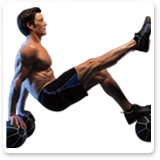 So
what is this equipment? Here's a list of the equipment needed, which
we'll go into in detail in a later article. Did I say "needed"? It's not,
really. Besides the hotel room option, we also do most movements in a variety
of ways to make it easy to add equipment as you can afford it. Here's a
prioritized list: So
what is this equipment? Here's a list of the equipment needed, which
we'll go into in detail in a later article. Did I say "needed"? It's not,
really. Besides the hotel room option, we also do most movements in a variety
of ways to make it easy to add equipment as you can afford it. Here's a
prioritized list:
- Bands and/or weights: You
need some form of resistance.
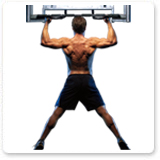
- Pull-up bar: Just like
P90X.
- Yoga mat: You must have
one of these by now, right?
- Stability ball: We highly
recommend this, because the benefits outweigh the cost many times over . . .
and over.
- Foam roller: You may not
have heard of this before, but don't be surprised if it
changes your
life.
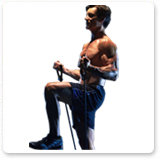
- Push-up stands: You know
'em. You love 'em. How come you don't already have them?
- Medicine balls: Mainly
used for balance, so easily replaced with substitutes (basketballs, etc.) if
need be, though once you've used the real thing you'll wonder why you ever
waited to buy them.
- Pull-up assist: While
highly optional (we got away with chairs all these years), the pull-up assist
will not only improve your ability to finish all your reps, it'll greatly
improve both your form and exercise efficiency.
- Yoga blocks: If you need
these, you probably have them already.
 Foam rolling? What the?! Foam rolling is a myofascial release
technique. Hmm . . . not much help? Okay, how about this? It's a form of
self-massage that forces your muscles to lengthen and align properly. Used
regularly, it'll increase your mobility and range of motion and actually help
you get stronger, because it frees your muscles to work the way they're
supposed to. This one simple practice is often enough to change your alignment
and allow you to move freer and easier. Foam rolling? What the?! Foam rolling is a myofascial release
technique. Hmm . . . not much help? Okay, how about this? It's a form of
self-massage that forces your muscles to lengthen and align properly. Used
regularly, it'll increase your mobility and range of motion and actually help
you get stronger, because it frees your muscles to work the way they're
supposed to. This one simple practice is often enough to change your alignment
and allow you to move freer and easier. How has the diet plan changed? For
P90X2, the diet has evolved along with the exercise plan. Not that there was
anything wrong with the old one, but we've been listening to your suggestions,
and we've revamped the diet guide to give you more options on what to eat, how
to increase effectiveness, and how to simplify the entire eating process. This
subject is more than we can cover here, so the X2 nutrition plan is the topic
of next week's P90X2 article. How has the diet plan changed? For
P90X2, the diet has evolved along with the exercise plan. Not that there was
anything wrong with the old one, but we've been listening to your suggestions,
and we've revamped the diet guide to give you more options on what to eat, how
to increase effectiveness, and how to simplify the entire eating process. This
subject is more than we can cover here, so the X2 nutrition plan is the topic
of next week's P90X2 article. |
|